As an Amazon Associate, we earn from qualifying purchases. Some links on this site are affiliate links at no extra cost to you. Our recommendations are based on thorough research and editorial judgment.


What Are The Basic Basketball Rules Every New Player Should Know?

New basketball players must grasp fundamental rules, which include the objective of outscoring opponents by shooting into their basket and understanding player positions such as Point Guard and Center. Key concepts include a jump ball to start, along with offensive strategies that prioritize scoring, and defensive techniques focused on denying scoring opportunities. Players should also be familiar with the significance of dribbling rules, types of fouls, and common violations like traveling and goaltending; further insights enhance comprehension of gameplay dynamics.
Key Takeaways
- Players must dribble the ball while moving; double dribbling results in a turnover.
- Traveling violations occur if a player lifts their pivot foot before dribbling.
- Teams must stay within the court boundaries; stepping out results in loss of possession.
- Proper defensive play requires active hands and maintaining balance to contest shots.
- Fouls, such as personal and technical, can lead to free throws for the opposing team.
Game Objective and Structure
You may be interested


In the domain of basketball, the game objective and structure provide an extensive framework that guides player participation and strategy development. The primary aim is to outscore the opponent by successfully shooting the ball into their basket, a goal complemented by specific scoring strategies. Within each game phase, teams contend for control of the rectangular court, divided by a mid-court line, and exchange baskets at halftime to guarantee equitable conditions. Points are accumulated through field goals—worth two or three points, depending on the shooting distance—and free throws, which offer one point each when awarded due to fouls. Game play is structured around periods, with overtime available if necessary, highlighting the dynamic nature of team strategies and scoring opportunities within this competitive environment. Effective traction patterns enhance player movement and stability on the court, contributing to overall performance.
Player Positions and Roles

The roles of players on a basketball team are categorized into five primary positions, each designed to fulfill specific functions that contribute to the overall strategy and efficiency of the team.
- Point Guard (PG): Responsible for ball handling and playmaking, requiring high basketball IQ and minimal turnovers.
- Shooting Guard (SG): The main scorer, adept at shooting long-range and creating opportunities off the dribble.
- Small Forward (SF): Versatile in offensive and defensive roles, showing role adaptability through scoring and rebounding.
- Power Forward (PF): Focused on inside play and rebounding, often setting screens and participating in post plays.
- Center (C): The team’s strongest player, crucial for rebounding and shot-blocking near the basket, needing agility despite size.
These positions create a cohesive unit essential for team dynamics, and each player can further enhance their skills with diverse training tools that improve coordination and performance.
Jump Ball and Game Start
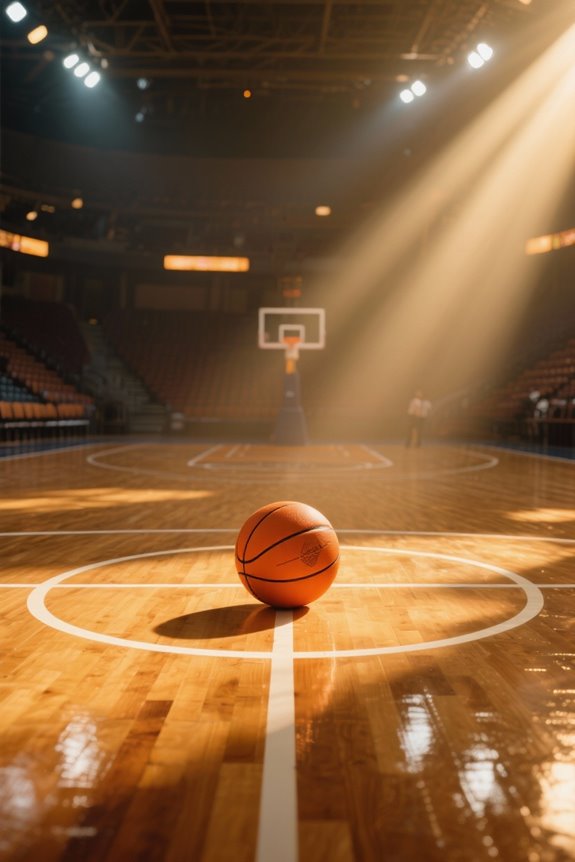
Jump ball serves as the ceremonial initiation of a basketball game, marked by a precise and regulated exchange of possession between opposing players. The jump ball procedure begins at the center circle, where two designated jumpers face off. Each must adhere strictly to positional rules, with both feet remaining within their designated half until the ball is tapped. Particularly, jump ball violations, such as early departures from the circle or illegal taps, result in the ball being awarded to the opposing team. Although the joy of starting the game is palpable, the process is structured to guarantee fairness; should both teams commit violations, the jump ball is simply replayed, allowing for a fresh start to determine possession. This excitement can be enhanced by unique basketball stickers that fans can use to personalize their gear and showcase their love for the game.
Offense and Defense Dynamics

Mastering the dynamics between offense and defense is essential for any basketball player, as these elements form the foundation of effective gameplay.
Offensive Strategies
Utilizing cutting techniques, players must prioritize purposeful movements towards scoring opportunities, while adhering to spacing principles to avoid congestion. Offensive formations, such as the Princeton Offense, optimize floor spacing, enhancing passing angles.
Defensive Tactics
Effective post defense requires active positioning to deny easy entry passes and disrupt offensive rhythm. Implementing disciplined defensive tactics, like denying passing lanes, forces challenging shots, thereby minimizing scoring efficiency.
Shift Dynamics
Shift offense emphasizes quick scoring before defensive setups, while shift defense necessitates immediate recovery from defenders to prevent easy fast-break points, highlighting the importance of balanced spacing. These elements collectively foster successful gameplay. Additionally, incorporating proper stretching routines can help players maintain flexibility and reduce the risk of injuries during intense gameplay.
Ball Handling and Movement Rules

Effective ball handling and movement rules are fundamental to a player’s success on the court, establishing a framework that governs dribbling, passing, and pivoting techniques.
Dribbling Techniques
- Dribbling involves continuously bouncing the ball while advancing.
- Players must not carry or palm the ball, ensuring their hand remains on top while dribbling.
- A double dribble occurs when a player uses both hands or resumes dribbling after stopping.
Pivoting and Movement
- The pivot foot remains planted while a player maintains control.
- Lifting the pivot foot before dribbling, passing, or shooting results in a traveling violation.
- Violations, such as traveling, result in the ball being awarded to the opposing team. Understanding these rules enhances player control, promotes fair play, and fosters teamwork.
Understanding these rules enhances player control, promotes fair play, and fosters teamwork.
Scoring Methods and Points
Scoring methods within basketball form the foundation of competitive play, dictating how teams accumulate points throughout a game. The primary scoring techniques encompass field goals and free throws, each essential to a team’s strategy.
Field Goals
- Field goals vary in value, with two-point shots awarded when the shooter is inside the three-point arc and three-point shots for those beyond the arc.
- These shots can include layups, jump shots, and dunks, with strategic placement influencing success.
Free Throws
- Free throws result from fouls, offering one point per attempt, and are uncontested, allowing players up to ten seconds to shoot.
- These points can greatly affect the game’s outcome, especially in close contests, highlighting their importance in effective scoring. Additionally, understanding cushioning systems can help players maintain their performance while making crucial shots under pressure.
Game Timing and Shot Clock
In the domain of basketball, understanding game timing and the intricacies of the shot clock is essential for both players and spectators, as these elements dictate the pace and strategy of the game. A standard basketball game consists of either four quarters or two halves, with game clock durations varying by competition, such as 12 minutes in the NBA or 20 minutes in college.
The shot clock, which ranges from 24 to 35 seconds depending on the league, begins once the offensive team controls the ball. The shot clock resets upon various conditions, including a change in possession or a shot that hits the rim. Furthermore, it pauses for fouls, timeouts, and other interruptions, maintaining the game’s structured flow.
Timeouts and Substitutions
Timeouts in basketball play an essential role in shaping the strategy and flow of the game, providing teams the opportunity to regroup, communicate tactics, and make necessary adjustments. Each team is allotted a varying number of timeouts based on the league, such as seven charged timeouts in the NBA during regulation play. Those timeouts can notably influence timeout strategies, as teams often utilize them to disrupt the opponent’s momentum or to strategize before critical plays.
Substitutions allow teams to change players, providing opportunities for fresh legs and tactical adjustments. Each league has specific substitution patterns, influencing how coaches rotate players throughout the game, ensuring ideal team performance while adhering to established rules regarding timeout duration and the timing of substitutions.
Types of Fouls and Infractions
Understanding the various types of fouls and infractions in basketball is essential for new players seeking to navigate the complexities of the game effectively. Key foul types include:
- Personal Fouls: Illegal physical contact affecting play, leading to free throws depending on circumstances.
- Flagrant Fouls: Classified as Flagrant 1 or Flagrant 2, these involve unnecessary to excessively violent contact and carry significant impact penalties, often resulting in ejection.
- Technical Fouls: Result from unsportsmanlike conduct, leading to free throws and potential player ejections.
- Offensive Fouls: Occur when the offensive player makes illegal contact, causing possession changes.
- Loose Ball Fouls: Happen during contested loose balls and affect team foul totals.
Recognizing these foul types is vital for maintaining sportsmanship and ensuring fair play.
Common Violations in Basketball
Basketball, as a fast-paced and structured sport, is governed by a set of common violations that players must comprehend to guarantee compliance with the game’s rules.
Dribbling Violations include double dribbles, traveling, and carrying, each resulting in a turnover.
Out of Bounds Violations occur when the last player to touch the ball causes a loss of possession, and players must not re-enter after stepping out during a dribble.
Goaltending Interference is penalized when a defender affects the ball’s trajectory within the basket area.
Backcourt Violations happen when the ball is returned to the defensive half after crossing midcourt.
Finally, failure to comply with shot clock rules and committing delay game violations results in turnovers, impacting a team’s control of the ball.
Rules for Defensive Play
Defensive play in basketball constitutes a significant component of the game, requiring players to employ a variety of techniques and strategies to effectively counteract offensive actions.
Recommended Products

Acquire better defensive skills with an innovative training device that every coach, trainer and athlete should incorporate into their workouts.
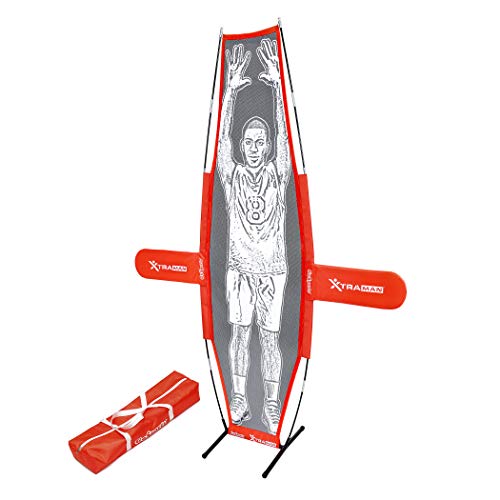
PRO DEVELOPED: The XTRAMAN was developed by GoSports in collaboration with professional basketball coaches and players to deliver a versatile training aid for players of all abilities

【2 styles to choose】There are shooting style and dribbling style available. The hand shaped blocker of the shooting style is fixed, which can improve the shooting accuracy. The blocker of dribble style can be shaken to simulate the actual field of view during dribbling, enhancing your control over the ball and passing ability. You can choose the style you need based on your training situation. Whether used indoors or outdoors, it forces you to use residual light for observation
Defensive Fundamentals
- Players must adopt a balanced stance, keeping feet slightly wider than shoulder width, with knees bent and weight on the balls of the feet.
- Active hands are vital; one hand contests the ball while the other obstructs passing lanes.
Guarding Techniques
- Employ denial defense by positioning between the opponent and the ball.
- In closeout scenarios, sprint towards shooters before shifting to short steps to maintain control and avoid fouling.
Legal Guarding
– Establish legal guarding position with both feet grounded, using patience and good footwork to avoid fouls, thereby ensuring effective defensive presence.
These techniques are necessary for developing an effective defensive strategy on the court.
Fundamental Skills to Master
Acquiring fundamental skills in basketball is paramount for players aspiring to excel in the sport, as these competencies serve as the foundation for both individual performance and team dynamics. Key areas include:
- Shooting Accuracy: Mastering proper shooting form with consistent follow-through builds confidence.
- Dribbling Techniques: Effective control is achieved through fingertip dribbling and varied speeds, essential for maneuvering through defenses.
- Passing Precision: Utilizing a variety of pass types enhances teamwork, facilitating smoother ball movement.
- Footwork Mastery: Proper footwork aids in balance and positioning, whether for shooting or defending.
- Rebounding Strategies: Timing and positioning near the basket are critical for successful rebounds, enhancing possession control.
- Court Awareness: Understanding player dynamics and game flow informs better decision-making, fostering effective teamwork and strategy.
Frequently Asked Questions
How Many Total Players Can Participate in a Basketball Game?
In a standard basketball game, 10 players engage on the court at once—five per team. Game substitutions allow for strategic adjustments, enabling teams to rotate players and adapt to emerging game dynamics and player positions.
What Happens if a Player’s Foot Touches the Three-Point Line?
If a player’s foot touches the three-point line during a shot, it results in a two-point basket. Proper foot positioning is essential to maximize scoring opportunities and guarantee clarity in basketball gameplay for all participants.
Can the Ball Be Passed With One or Both Hands?
Of course, one can pass the ball with either hand, as if choosing between a sandwich or a salad at lunch. Mastering passing techniques and hand coordination can elevate one’s game from merely average to extraordinary.
What Are the Dimensions of a Standard Basketball Court?
A standard basketball court measures 94 feet long by 50 feet wide, featuring a distinct court layout with markings such as the free throw line and key area, ensuring players understand spatial dynamics during the game.
How Is the Shot Clock Violation Enforced?
In a critical game moment, a player’s last-second shot fails to hit the rim before the shot clock expires, resulting in a violation. Officials swiftly enforce the violation rules, awarding possession to the opposing team.


