As an Amazon Associate, we earn from qualifying purchases. Some links on this site are affiliate links at no extra cost to you. Our recommendations are based on thorough research and editorial judgment.


What Lighting Requirements Are Needed For Outdoor Basketball Courts?

Outdoor basketball courts necessitate specific lighting requirements to guarantee safety and ideal visibility during gameplay. High school games should achieve a minimum of 200 lux, while professional settings require an average of 2,000 lux. Uniformity ratios should be at least 0.5 to minimize shadows, with fixtures placed to avoid glare. Energy-efficient LED lighting, maintaining a CRI of 80, is recommended due to its longevity and reduced energy consumption. Further considerations arise regarding maintenance and overall lighting design to enhance the gameplay experience.
Key Takeaways
- Minimum horizontal illuminance for competitive gameplay should exceed 200 lux for outdoor basketball courts.
- A uniformity ratio of at least 0.5 is necessary to minimize shadows and enhance visibility.
- Utilize anti-glare designs and strategically place fixtures to ensure player safety and reduce visual discomfort.
- Aim for a Color Rendering Index (CRI) of around 90 to improve visibility of jerseys and enhance refereeing decisions.
- Incorporate LED lighting for energy efficiency, providing longer lifespan and compliance with required lighting standards.
Recommended Illuminance Levels
You may be interested


The recommended illuminance levels for outdoor basketball courts are critical to guaranteeing ideal visibility and safety during play, with specific requirements varying based on the class of competition.
- Class I (International/professional): Requires 150 footcandles (fc), approximately 1,600 lux, suitable for televised games.
- Class II (National/regional): Falls between 50-75 fc (about 500-800 lux) for national events.
- Class III (Recreational/training): Ranges from 20-30 fc (200-300 lux) for casual play.
Proper lighting intensity must guarantee a uniformity ratio of at least 0.7 to minimize shadows and enhance player safety. Additionally, an adequate color rendering index (CRI) of ≥80 is essential for accurate visibility, reflecting the importance of meeting specific illuminance standards for various competitive levels. Furthermore, ensuring high-quality durability of basketball shoes can contribute to a safer playing environment, as players will have better footing and traction on well-lit courts.
High School Game Lighting Standards

Uniformity Ratio: Aiming for a Uniformity Ratio around 0.5 for recreational-level events reflects an adequate consistency in lighting, essential for minimizing shadows that could impair player safety. High school basketball courts require specific standards to enhance player visibility, ensuring that all participants can recognize their teammates, the ball, and court lines with ease. Ideally, horizontal illuminance should exceed 200 lux, accommodating competitive gameplay while preventing dark spots. Fixtures must avoid direct placement above the basket to eliminate glare, fostering effective lighting safety by maintaining balanced vertical illuminance. The minimum Color Rendering Index (CRI) should be 80, ensuring accurate color perception under artificial conditions, ultimately contributing to a safer, more enjoyable experience for players and spectators alike. Additionally, the use of BOOST technology in athletic footwear can enhance player performance on the court, supporting quick movements and agility.
Requirements for Televised Professional Games

When organizing televised professional basketball games, compliance with stringent lighting requirements becomes essential for ideal viewer experience and athlete performance. To achieve broadcast quality, a minimum average illuminance of 2,000 lux (approximately 185 footcandles) is recommended, with vertical illuminance averaging 1,700 lux or higher for best camera visibility. The International Basketball Federation (FIBA) establishes a baseline of 150 footcandles for televised events. In addition, uniformity in lighting is paramount; the ratio of maximum to minimum illumination must not exceed 1.7:1, preventing shadows on the court. Preferred color temperatures range from 5,500K to 6,000K to simulate daylight conditions, while a high Color Rendering Index (CRI) of 90 and above guarantees accurate color representation, enhancing the viewing experience. Moreover, ensuring proper traction for athletes is crucial for maintaining performance and safety on the court.
Recommended Products

ATTENTION - NOT COMPATIBLE WITH ALL POLE TYPES, PLEASE MEASURE YOUR POLE BEFORE ORDERING.

Enjoy the fun of playing basketball at night: The basketball hoop basketball board light is equipped with an upgraded LED bulb and a new version of the 32-button remote control, which can illuminate the edge of the basketball hoop for you, making your basketball hoop more attractive and brighter, with this At the same time increase children's interest in playing basketball. (Rim and Backboard not included)

POWERFUL, LONG-LASTING — Silverback LED hoop lights illuminate backboard, rim, and court to help maximize practice time
Lighting for Recreational Outdoor Courts

Adequate lighting for recreational outdoor basketball courts is essential not only to guarantee player safety and performance but also to enhance the overall visibility of the game for participants and spectators alike. Recreational courts should achieve illuminance levels between 20 to 30 foot-candles to secure basic visibility, effectively mitigating lighting challenges that could hinder gameplay. The placement of fixtures, typically mounted up to 30 feet high, must be strategic to avoid glare, particularly during critical moments like shooting. Furthermore, maintaining a minimum uniformity ratio around 0.5 to 0.6 is necessary to minimize shadows. By utilizing LED lighting, courts can enhance color rendering while also promoting energy efficiency, ultimately fostering an inviting environment where players feel safe and connected to the game. Incorporating these principles of lighting for sports can significantly improve the overall experience for both players and viewers.
Importance of Uniformity Ratio

The significance of maintaining an ideal uniformity ratio in outdoor basketball lighting cannot be overstated, as it directly impacts both player performance and overall game safety. A uniformity ratio quantifies the consistency of illuminance across the court surface, with lower ratios ensuring minimal differences between the brightest and dimmest areas. Effective lighting techniques promote visibility enhancement, thereby reducing visual discomfort and shadows that can impair player depth perception. The Illuminating Engineering Society (IES) recommends specific ratios according to the competition level, such as 2:1 for non-televised courts and 1.5:1 for professional venues. Achieving these ratios fosters a more equitable playing environment, allowing players and officials to perform with confidence while enriching the spectator experience through superior visual consistency. Additionally, proper lighting can enhance overall athletic capability, ensuring that players can execute their skills without hindrance.
Advantages of LED Lighting
Considering the myriad advancements in outdoor sports lighting, LED technology stands out due to its numerous advantages that directly enhance court performance and sustainability.
Energy Efficiency and Cost Savings
- LEDs remarkably reduce energy consumption, using up to 75-80% less electricity than traditional lighting.
- Lower utility bills and potential rebates make initial installation more manageable, resulting in long-term financial benefits.
Longevity and Maintenance Reduction
- With an average lifespan of 50,000 hours, LEDs minimize the need for frequent replacements, especially in challenging outdoor settings.
- Their durability guarantees reliable operation in various weather conditions, further reducing maintenance costs.
Superior Illumination Quality
- LED lights offer bright, even illumination, improving safety and performance while reducing glare and shadows.
- Customizable brightness levels enhance adaptability for different game conditions, contributing to an ideal sporting environment. Additionally, the use of durable materials in basketball hoops can help improve overall play quality in outdoor settings.
Recommended Products

LIGHT UP THE COURT - transform nighttime basketball games with our HoopBrightz basketball light, featuring weather-resistant, diamond-bright multicolor LEDs that ensure the game never ends, even after dark. Perfect for any outdoor basket ball hoop

LIGHT UP BASKETBALL RIM AT NIGHT: Our LED Strip Light can light up the rim of the basketball hoop. It has 16 unique light patterns, making your basketball hoop more attractive and bright. It boosts basketball lovers' interest in playing basketball and lets them enjoy the fun of playing basketball at night!

Light Up Rim and Backboard: The basketball rim lights brightly illuminates both rim and backboard in vibrant LED colors. Choose from 16 single colors (red, green, blue, pink, orange, white, amber, purple) and 8 two-color combos. Party mode features 7 lighting effects—Fade, Jump, Twinkle, and more. Whether shooting at dawn or hosting a night game, you'll see the rim and backboard clearly, shoot confidently, and play longer with more joy
Optimal Color Temperature for Basketball Courts
Effective basketball court lighting relies considerably on the color temperature of the lighting system employed, as it directly influences visibility, player performance, and spectator experience. The recommended color temperature typically ranges from 4000K to 6000K, as this range guarantees peak performance during play. Specifically, temperatures of around 4000K to 5000K offer bright white light that reduces glare, whereas 5500K to 6000K mimics natural daylight, enhancing clarity and visibility. Color temperature impacts players’ ability to track the ball and opponents, while minimizing visual fatigue and shadows. In addition, modern LEDs allow for dynamic color temperature adjustments, maximizing lighting for various activities and improving overall engagement for both players and spectators, assuring a safer and more enjoyable environment.
Color Rendering Index (CRI) Requirements
Understanding the Color Rendering Index (CRI) requirements for outdoor basketball courts is essential for optimizing visibility and overall gameplay experience.
- CRI Standards: Professional events necessitate a CRI between 80 and 90 for accuracy, while college courts stabilize around 80. High school and recreational courts function well with CRI values around 60, given the absence of broadcast demands. Outdoor recreational courts ideally maintain a high CRI of approximately 90.
- CRI Impact: Elevated CRI enhances team jersey differentiation, ball tracking, and referee decision-making, ultimately improving player performance. A CRI below 80 can result in washed-out colors that negatively affect on-court perception. High CRI contributes to visual clarity under varied lighting conditions, supporting an engaging experience for both players and spectators.
Anti-Glare Designs and Their Importance
Anti-glare designs are paramount in the lighting configuration for outdoor basketball courts, as they greatly enhance visibility and safety for both players and spectators. Glare reduction is essential, as excessive glare can induce discomfort, disrupt visual performance, and increase the risk of accidents. By employing anti-glare fixtures, which direct light downward and away from players’ line of sight, courts achieve improved player tracking and uniform lighting. This enhances lighting aesthetics, making the court more inviting and pleasant for all. Additionally, adherence to recognized standards, such as the IES RP-6-20, guarantees effective glare management. Implementing these designs not only benefits players but also enhances the overall viewing experience for spectators, fostering a sense of community around the game.
Recommended Products

Ultra-Bright & Energy Efficient for Multiple Applications: STASUN 600W LED Flood Light delivers 60,000LM of 6000K daylight, equivalent to 5000W traditional lighting, while saving 88% on energy costs. Ideal for stadiums, sports arenas, parking lots, farmyards, construction sites and outdoor security lighting, providing powerful and reliable illumination

Ultra-Bright & Energy-Efficient Plug-In Flood Light: STASUN MINI Series 300W LED Flood Light delivers up to 60,000 lumens of 6000K daylight, replacing traditional 5000W fixtures while saving up to 88% on energy costs. Designed with a plug-in power cord, it’s ideal for backyards, driveways, garages, patios, and outdoor security lighting where fast installation is needed.

【Light Up Basketball Rim Light at Night】 The basketball hoop lights can light up basketball hoop, up to 17 unique light mode, It was really cool to all the colors and they are bright enough, let all the kids in the neighborhood thought that your kids had the coolest rim on the block and makes playing at night really fun.
Mounting Height and Fixture Placement
The proper mounting height and strategic fixture placement are essential components in the design of outdoor basketball court lighting systems, influencing not only the quality of illumination but also the overall safety and gameplay experience.
Standard pole heights for outdoor courts typically range from 20 to 30 feet, with half-courts requiring 20-foot poles and full-size courts necessitating heights from 25 to 30 feet. Fixture placement should prioritize sideline positioning to minimize player glare, with poles evenly spaced along the sidelines for uniform light distribution.
Optimal angles and heights mitigate glare and shadows, ensuring effective lighting. The average ground illuminance targets—420 lux for training courts and 660 lux for competitive play—highlight the importance of proper mounting height and meticulous fixture placement in achieving appropriate illumination standards.
Recommended Products
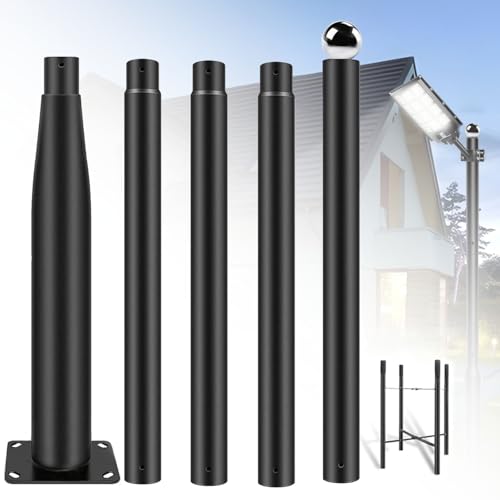
Exceptional Durability: Made of premium steel for heavy-duty architectural use, this street light pole features thick zinc coating for superior corrosion/rust resistance. Withstands harsh outdoor elements, ensuring longevity as reliable light poles for outside.

Utral-large lights & Upgraded Waterproof: Our Loyoele Utral-large solar street lights outdoor with newly upgraded waterproof backplane adopt nanoscale waterproof coating.Its waterproof protection performance far more beyond all another solar street light in current market.

PERFECT FIT: This 20-foot street light pole has a 3-inch top mounting interface and a 5-inch base for stability. Its 48.5 lbs weight and sleek black finish make it easy to handle and install for optimal performance.
Energy Efficiency of LED Lighting
Energy efficiency stands as a pivotal advantage of LED lighting in outdoor basketball courts, demonstrating significant benefits that resonate both economically and environmentally.
LEDs convert nearly 80% of electrical energy into light, greatly minimizing waste attributed to heat. With energy consumption up to 75% lower than metal halide lamps, they foster considerable energy savings while reducing light pollution, a growing concern in urban areas. The operational lifespan of up to 50,000 hours further decreases replacement frequency, thereby lowering overall resource consumption.
Additionally, the integration of smart controls enhances efficiency through optimized lighting schedules. By utilizing LEDs, sports venues contribute to diminished greenhouse gas emissions, progressing toward a more sustainable future. In total, these attributes establish LEDs as an essential choice for modern outdoor sports lighting.
Maintenance Considerations for Outdoor Lighting
Effective maintenance of outdoor lighting systems is essential for ensuring ideal functionality and safety in basketball courts, as various protocols can greatly impact both performance and longevity.
To achieve optimal results, the following considerations are crucial:
- Maintenance Frequency: Regular cleaning of fixtures and annual inspections are recommended to remove debris and verify structural integrity.
- Fixture Inspection: Inspect poles and fixtures for damage, ensuring alignment for uniform light distribution; misalignment may occur due to environmental factors.
- Component Replacement: Implement group relamping strategies for efficiency, and schedule professional assistance for high-maintenance tasks involving HID or metal halide bulbs.
- Weatherproofing: Utilize weatherproof enclosures and inspect protective elements consistently to enhance durability.
Such practices collectively safeguard lighting performance and extend the useful life of outdoor illumination systems.
Recommended Products

【Super Bright Floodlight】Outdoor Flood Lights are equipped with 180 high -quality 2835 lamp beads, which are more effective than traditional fluorescent lamps or incandescent lamps. This helps reduce energy consumption and electricity costs, and provide additional safety guarantees for your warehouses, lanes, parking lots, etc.

HIGH EFFICIENCY SERIES:Energy saving high quality LED SMD Floodlight will significantly reduce your energy bills

【Solar Powered & 0 Fees】 — Gefolly SL-18000W solar parking lot light is built-in 92pcs 5054 ultra bright LED lamp beads and 60000mAh battery (lifetime up to 65,000 hours). Provides a 6500K, IP67 waterproof rating, and works normally even in bad weather all year round. Solar powered, no electricity bill, auto turns on at dusk and charging during the day, Continuous lighting up to 30 hours (when fully charged). Best for commercial and home lighting.
Lighting Design for Gameplay Experience
Lighting design plays a pivotal role in enhancing the gameplay experience on outdoor basketball courts, as it directly influences visibility and player performance. Effective lighting systems must achieve a recommended illuminance of 200 to 300 lux for recreational play, ensuring players can track the ball with ease. Ideal color temperatures between 4000K and 6000K provide natural color visibility, enhancing the players’ ability to differentiate jerseys and court markings. Additionally, anti-glare measures are essential for maintaining player safety, preventing visual discomfort and ensuring focus during fast-paced games. The strategic positioning of poles and lighting fixtures not only supports lighting aesthetics but also fosters a sense of community among players and spectators, contributing to a positive and engaging sports environment.
Compliance With Standards and Codes
Ensuring compliance with established lighting standards and codes is critical for the ideal functioning of outdoor basketball courts, as these regulations not only enhance player safety but also uphold the integrity of the game. Various compliance standards dictate the required illuminance levels—typically measured in footcandles (fc) or lux—ensuring that conditions are adequate for both gameplay and broadcasting. According to outdoor regulations, lighting must meet specific requirements for uniformity, color temperature, and safety. For instance, fixtures must achieve a minimum CRI of 80, while professional setups may require a minimum of 2000 lux. Furthermore, adherence to IP65 ratings for weather resistance forms part of standard compliance, promoting longevity and reliability in outdoor settings, consequently fostering community engagement through safe playing environments.
Frequently Asked Questions
How Can Weather Conditions Affect Outdoor Basketball Court Lighting?
Weather conditions greatly impact outdoor illumination, affecting light performance and fixture durability. Factors like humidity, temperature variations, and precipitation necessitate careful weather considerations to guarantee consistent lighting quality, enhancing safety and player experience on the court.
What Are the Typical Costs Associated With Installing Sports Lighting?
Typical installation costs for sports lighting range from $10,000 to $40,000, influenced by fixture quality and court specifications. Additionally, maintenance expenses are lower for LED systems, offering efficiency and long-term savings for community facilities.
How Do Lighting Designs Differ Between Indoor and Outdoor Courts?
Lighting designs for indoor and outdoor courts diverge considerably; outdoor setups prioritize broad coverage and durability, enhancing player visibility on varied court surfaces, while indoor designs focus on uniformity and aesthetics to enhance overall experience and engagement.
What Types of Fixtures Are Best for Energy Efficiency?
LED fixtures are ideal for energy efficiency, offering substantial savings and low maintenance. Incorporating solar lighting, conducting energy audits, and adopting proactive maintenance practices enhance their performance, ensuring communities enjoy well-lit outdoor basketball courts sustainably.
How Often Should Lighting Systems Be Inspected or Serviced?
In the grand scheme, consistent vigilance is key. Therefore, inspection frequency should be at least twice yearly, accompanied by an extensive service checklist annually to guarantee peak performance and safety for all using the outdoor facilities.


